

Description
La casa fue construida originalmente en la década de 1930 como residencia y clínica para un médico, ubicada en la planta baja con su propia puerta de entrada, separada de la entrada a la vivienda familiar. Según el arquitecto en la revista Nuevas Formas, la casa tuvo que resolver ciertas dificultades decisivas: la relación entre los servicios de la clínica y la vivienda; la forma del terreno, que era desproporcionada en anchura (15,30 metros) en comparación con su longitud (43 metros), y la pendiente longitudinal que presentaba. Debido a su reducida dimensión transversal y la necesidad de separar la vivienda del consultorio, se proyectó una planta rígida con un amplio pasillo alrededor del cual se distribuyen las habitaciones. La disposición escalonada de las terrazas sitúa la casa en la parte más alta del terreno, aprovechando al máximo la luz natural que se reduce en la planta baja debido al gran tamaño del edificio vecino.
Programa: Partiendo del estado original de la casa, debe renovarse como un espacio de trabajo (para uno o varios profesionales) y como residencia para 5 miembros. El espacio de trabajo consiste en un laboratorio gastronómico con un área de análisis y una zona de cocina.
Usuarios: En este caso, los usuarios son los padres: un chef molecular y una científica especializada en ciencia de los alimentos. Dos profesionales apasionados por la cocina y por las nuevas formas de trabajar con los alimentos, que desarrollan en su laboratorio fórmulas y recetas innovadoras en este campo experimental.
Concepto: La gastronomía molecular es un estilo moderno de cocina que busca investigar las transformaciones químicas y físicas que se producen en los ingredientes durante su preparación. Esta rama nace de la mezcla entre creatividad y ciencia, en la que chefs y científicos interactúan entre sí. El objetivo es diseñar espacios creativos, técnicos y minimalistas en los que los ingredientes y utensilios se conviertan en el ornamento de cada estancia, entendiendo la casa como un laboratorio y no únicamente como un espacio de trabajo. En la gastronomía molecular se pretende generar experiencias tanto en la degustación como en la preparación de los alimentos; por ello, los espacios en los que se trabaja también deben envolver a los profesionales, buscando crear distintas experiencias durante el acto de cocinar. Esto se consigue diseñando entornos únicos y creativos que convierten el espacio en un objeto de estudio, en constante crecimiento y desarrollo.
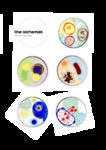
Me inspiré en la obra de la artista Klari Reis, conocida sobre todo por su serie Petri Dish, un conjunto multicolor de formas circulares creadas con una mezcla de materiales y técnicas innovadoras. Resulta interesante cómo el arte encuentra inspiración en la ciencia.
INGLES
The house was originally built in the 1930s as a residence and clinic for a doctor, located on the ground floor with its own entrance door, separated from the entrance to the family home. According to the architect in the magazine Nuevas Formas, the house had to solve certain decisive challenges: the relationship between the clinic’s services and the residence; the shape of the plot, which was disproportionate in width (15.30 meters) compared to its length (43 meters), and the longitudinal slope it presented. Due to its reduced transversal dimension and the need to separate the living quarters from the office, a rigid floor plan was drawn with a large hallway around which the rooms were arranged. The staggered layout of the terraces places the house on the highest part of the plot, making full use of natural light, which is reduced on the ground floor due to the large size of the neighboring building.
Program: Starting from the original state of the house, it must be renovated as a workspace (for one or several professionals) and as a residence for 5 members. The workspace consists of a gastronomic laboratory with an analysis area and a kitchen area.
Users: In this case, the users are the parents: a molecular chef and a scientist specializing in food science. Two professionals passionate about cooking and new ways of working with food, who develop innovative formulas and recipes in this experimental field within their laboratory.
Concept: Molecular gastronomy is a modern style of cooking that seeks to investigate the chemical and physical transformations that occur in ingredients during their preparation. This field was born from the combination of creativity and science, where chefs and scientists interact with each other. The goal is to design creative, technical, and minimalist spaces where ingredients and utensils become the ornament of each room, understanding the house as a laboratory, not only as a workspace. In molecular gastronomy, the aim is to create experiences both in the tasting and preparation of food; therefore, the spaces in which professionals work must also envelop them, seeking to generate different experiences during the act of cooking. This is achieved by designing unique and creative environments that turn the space into an object of study, in constant growth and development.
I was inspired by the work of artist Klari Reis, best known for her Petri Dish series, a multicolored set of circular forms created using a blend of media and groundbreaking techniques. It is fascinating how art finds inspiration in science.
Publication Date
2025
City
Madrid
Recommended Citation
Heredero Millán, Ana, "The Alchemist" (2025). Grado en Diseño de Interiores. 271.
https://sciencevalue.udit.es/tfg_interiores_producto/271